 sales@batterydeji.com

 English



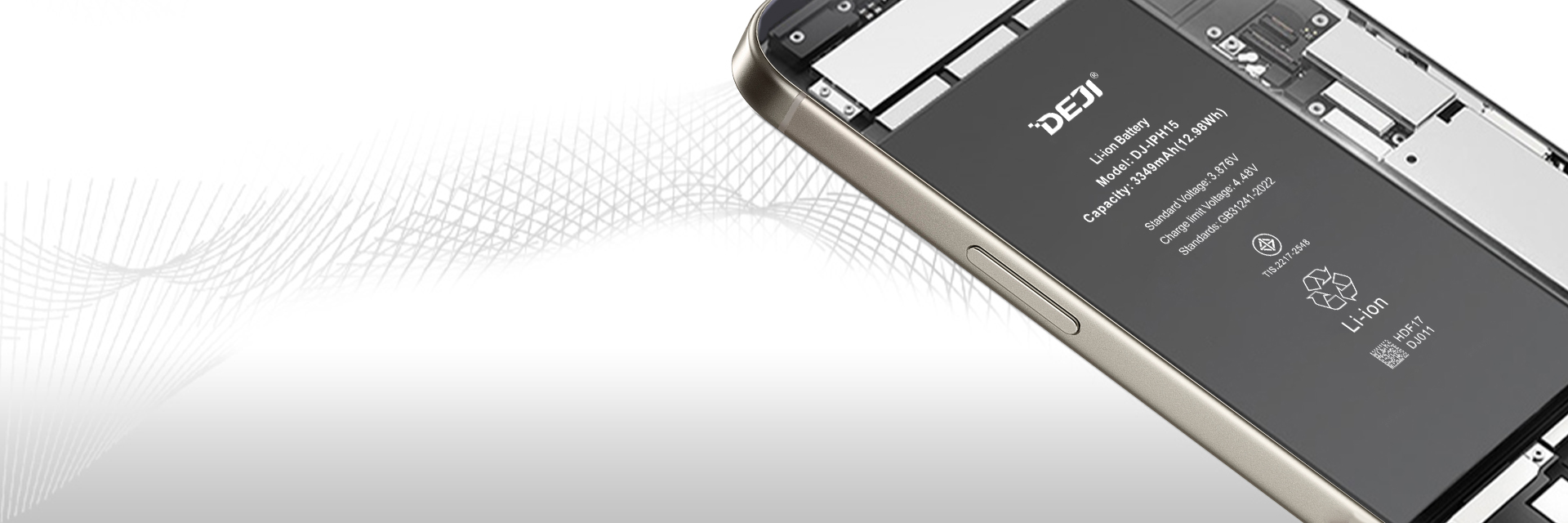

If you’ve already swapped hundreds of iPhone 16 batteries in your shop, you might think the 17 and 18 generations are just another mAh bump to keep up with. That’s the exact mistake that leaves technicians stuck mid-job, or distributors stuck with pallets of batteries that throw non-stop iOS verification pop-ups.
These two generations don’t just tweak capacity numbers — they rewrite the rules for how you select, install, and stock replacement batteries. DEJI breaks down the real, on-the-bench differences every repair shop, wholesale distributor, refurb house, and independent tech needs to know before placing that bulk order.
1. Executive Summary & Sourcing Verdict
The introduction of the iPhone 17 and iPhone 18 generations marks the most radical architectural transformation in smartphone battery design over the past decade. Driven by European Union battery right-to-repair mandates and aggressive thermal requirements for on-device AI processors, Apple has shifted entirely away from traditional aluminum laminated soft-pouch cells toward laser-welded stainless steel-cased enclosures and electrically induced adhesive de-bonding systems.
For wholesale distributors, repair franchises, and refurbishing facilities:
- Never attempt cross-generational SKU consolidation: While rated capacities push past 5,100 mAh (iPhone 17 Pro Max) and 5,567 mAh (iPhone 18 Pro Max), differences in internal busbar geometry, nominal operating voltages (3.87V vs 3.907V), and logic-board bracket mountings prevent cross-model installation.
- Upgrade workshop tooling: Standard manual stretch-release pull tabs are obsolete; repair lines must integrate low-voltage (9V–12V DC) debonding power supplies and calibrated adhesive replacement kits.
- Qualify BMS cryptographic decode solutions: Ensure all replacement assemblies support iOS Repair Assistant calibration to avoid Part History warnings and preserve dynamic power management.
2. Direct Technical Comparison Matrix
| Engineering Parameter | iPhone 17 Lineup (Standard / Air / Pro / Pro Max) | iPhone 18 Lineup (Standard / Pro / Pro Max) | B2B Sourcing & Quality Impact |
|---|---|---|---|
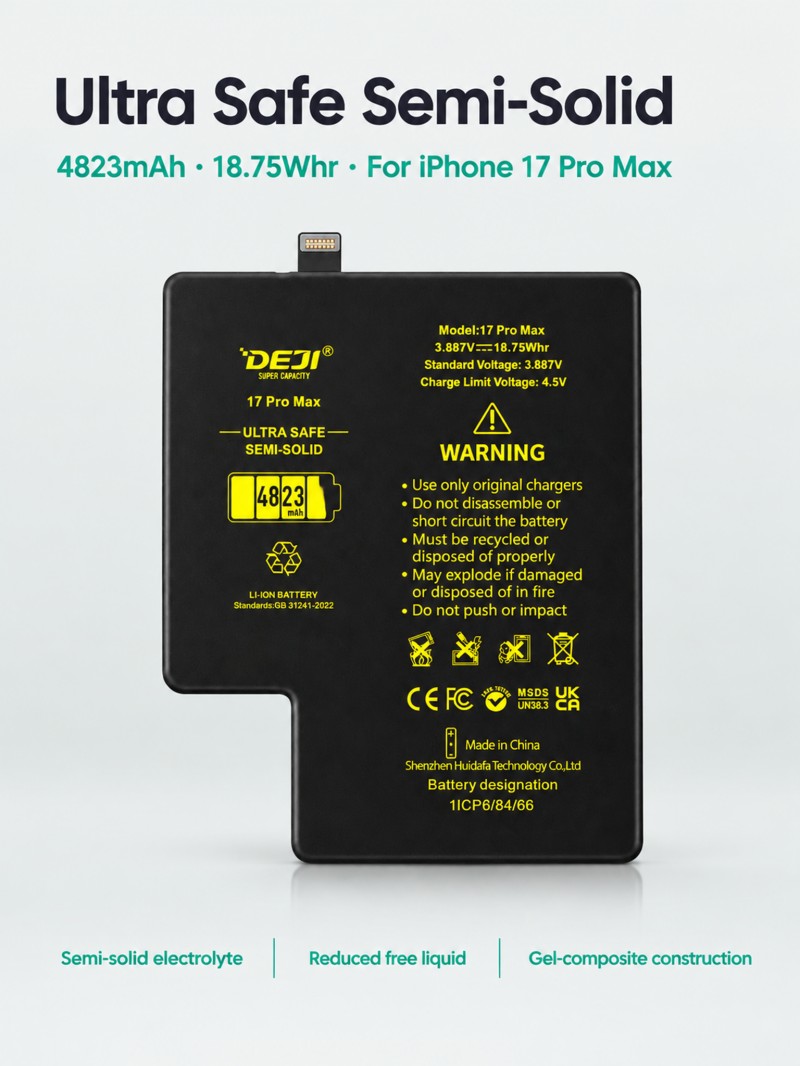
| Model Capacities (Standard / Rated) | • Base 17: 3,692 mAh • 17 Air: 3,149 mAh • 17 Pro: 3,988mAh / 4,252mAh • 17 Pro Max: 4,823mAh / 5,088mAh |
• Base 18: 3,850 mAh (14.98 Wh) • 18 Pro: 4,056mAh / 4,288mAh • 18 Pro Max: 4,056mAh / 4,288mAh |
iPhone 18 Pro Max delivers unprecedented 21.751 Wh energy reserve |
Note: For iPhone 17 Pro, Pro Max and iPhone 18 Pro models, the lower figures correspond to physical-SIM versions and the higher figures to eSIM-only versions. The iPhone 17 base figure above is the reported eSIM capacity. Figures are original battery reference capacities, not DEJI replacement battery specifications.
What Do These Capacity Differences Mean for Wholesale Buyers?
Three factors deserve attention:
1. Regional battery variations
Some iPhone models have different battery capacities depending on whether they support a physical SIM card or use eSIM exclusively. Distributors should confirm the exact device version before ordering replacement batteries.
2. Model-specific compatibility
A higher mAh rating does not automatically mean a battery is compatible with another iPhone model. Battery dimensions, connectors, flex cables, mounting positions, and BMS configurations must all match.
3. High-capacity replacement opportunities
The growing demand for longer battery life creates opportunities for aftermarket high-capacity batteries. However, actual capacity should be verified through controlled testing rather than relying solely on printed labels.
For repair businesses, consistent capacity, stable performance, and reliable quality control are more important than exaggerated capacity claims.
2. New Battery Design and Repair Technologies
One of the most interesting developments in recent iPhone generations is the evolution of battery installation and removal procedures.
2.1 Electrically Releasable Battery Adhesive
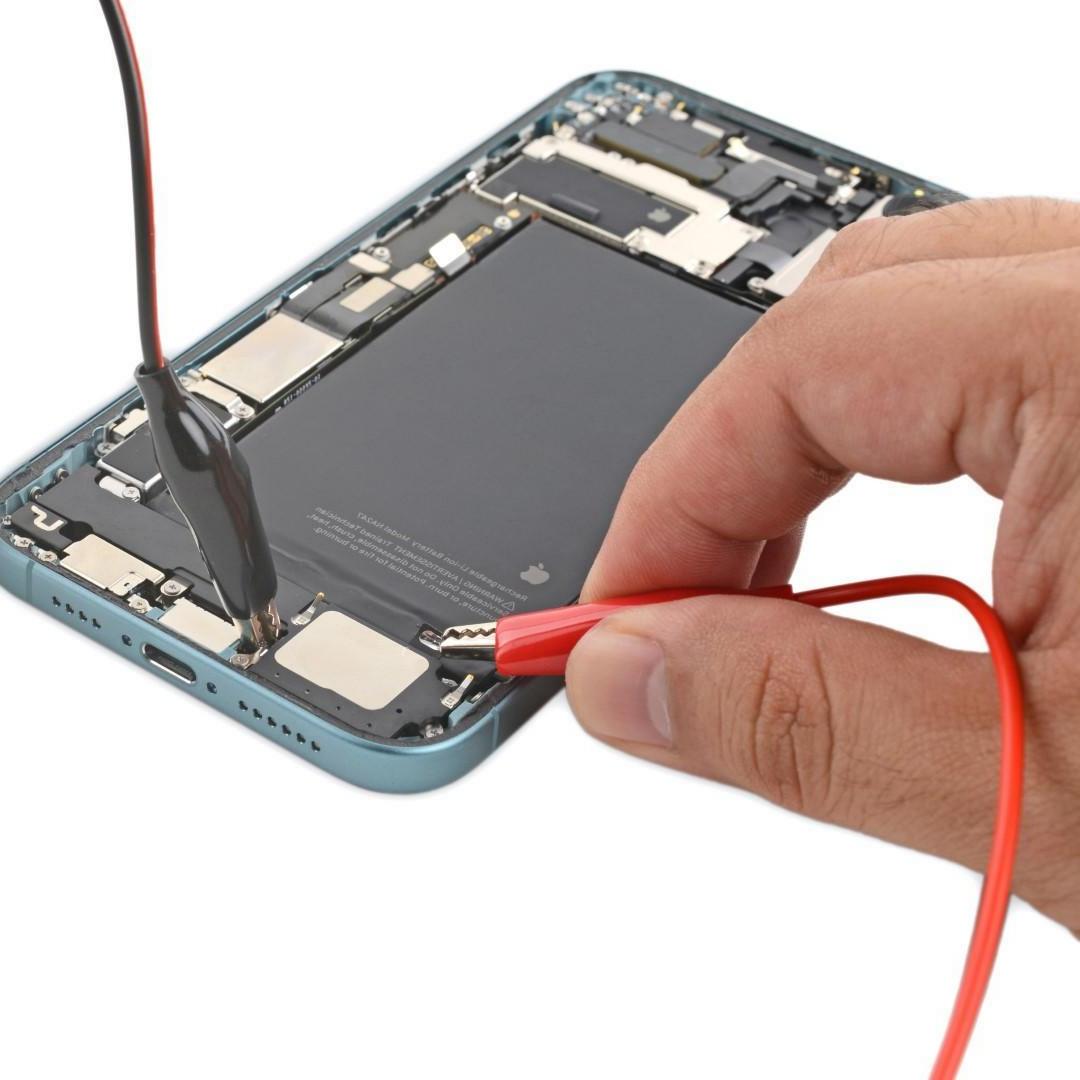
Some newer iPhone models use electrically releasable adhesive to simplify battery removal.
Instead of relying entirely on conventional stretch-release adhesive strips, technicians can apply an electrical current through the designated contact system to weaken the adhesive bond.
The iPhone 17 repair procedure documents this method, with a 9V power source applied for approximately 90 seconds under the specified procedure. iPhone 18 Pro teardown testing also demonstrated electrical adhesive release at approximately 12V for 90 seconds when separating the cell from its battery tray.
Benefits for repair professionals:
-
Can simplify battery removal.
-
Reduces dependence on conventional adhesive-pulling techniques for compatible designs.
-
Helps reduce the need for excessive mechanical force.
-
Supports more controlled battery replacement procedures.
However, electrical adhesive release is not universal across all iPhone models. Repair technicians should always follow model-specific instructions and use suitable equipment.
2.2 Metal Battery Tray Design
The iPhone 18 Pro and Pro Max introduce a notable battery installation feature: a metal battery tray secured with screws.
According to iFixit's teardown, the battery and tray can be removed together, while the cell itself remains bonded to the tray.
This design provides another approach to battery servicing and can simplify removal of the complete battery-tray assembly.
For aftermarket battery manufacturers, this highlights the importance of:
-
Accurate battery dimensions.
-
Correct mounting and positioning.
-
Compatible electrical connectors.
-
Proper insulation and mechanical protection.
-
Model-specific adhesive and installation solutions.
It is important to distinguish a metal battery tray from a steel-cased battery cell. They are not the same construction.
2.3 Battery Thermal Management
Modern smartphones require effective thermal management to support processors, cameras, fast charging, and demanding applications.
Battery quality is therefore not determined by capacity alone.
A professional replacement battery should be evaluated for:
-
Temperature stability during charging and discharging.
-
Internal resistance consistency.
-
Cell performance under load.
-
Charging and discharging protection.
-
Long-term capacity retention.
For wholesale distributors, these factors help reduce after-sales complaints and improve customer confidence.
3. iPhone Battery Compatibility: Why Cross-Model Installation Is Not Recommended
Can an iPhone 17 Pro Max battery be installed in an iPhone 18 Pro Max?
No. Replacement batteries should be selected according to the exact iPhone model and hardware version.
Even when two batteries have similar dimensions or capacities, they may have different:
-
Battery connectors and FPC layouts.
-
Physical dimensions and mounting structures.
-
Electrical specifications.
-
BMS configurations.
-
Installation and adhesive requirements.
A battery designed for one model should not be treated as a universal replacement for another.
What Should Distributors Check Before Ordering?
|
Inspection Item |
What to Verify |
|---|---|
|
Model compatibility |
Exact iPhone model and regional version |
|
Battery dimensions |
Length, width and thickness |
|
Connector |
FPC position and connector specification |
|
Rated capacity |
Verified mAh and Wh |
|
BMS |
Supported data and protection functions |
|
Installation |
Adhesive, tray and mounting compatibility |
|
Quality |
Cell consistency and safety test records |
For wholesale buyers, maintaining separate SKUs for each compatible model helps prevent incorrect shipments and installation problems.
4. BMS, Battery Health Display and iOS Repair Assistant

The Battery Management System (BMS) plays an important role in modern smartphone batteries.
It monitors and manages battery-related information, including:
-
Battery voltage.
-
Charging and discharging conditions.
-
Temperature monitoring.
-
Battery health information.
-
Cycle-count data, where supported.
Understanding Genuine, Used and Unknown Battery Messages
Apple provides Parts and Service History to help users identify replacement components.
Depending on the battery and repair process, an iPhone may display different statuses:
|
Display Status |
General Meaning |
|---|---|
|
Genuine |
Recognized genuine Apple component |
|
Used |
Previously used or installed component |
|
Unknown Part |
Component cannot be verified or is not functioning as expected |
|
Finish Repair |
Repair Assistant process needs to be completed |
Apple's official documentation explains that Repair Assistant may be required to complete the installation of a genuine replacement part. It also explains the circumstances in which an Unknown Part message may appear.
Apple Support (SG)
What Should Buyers Expect from Aftermarket Batteries?
When evaluating aftermarket iPhone batteries, buyers should check:
-
Whether battery health information is supported.
-
Whether battery data can be configured correctly.
-
Whether charging and discharging functions operate normally.
-
Whether the product has been tested with the intended iOS versions.
-
Whether the supplier provides clear compatibility information.
A responsible supplier should distinguish between battery functionality, battery health display, and Apple's genuine-part verification.
These are separate technical capabilities and should not be confused.
5. Frequently Asked Questions (FAQ)
Q1: Can an iPhone 17 Pro Max battery be installed in an iPhone 18 Pro Max?
Strictly No. The iPhone 18 Pro Max battery operates on a higher nominal voltage (3.907V vs 3.87V) and features a physically larger footprint to accommodate its massive 5,567 mAh (21.75 Wh) capacity. Connecting a 17 Pro Max pack will cause power rail under-voltage shutdowns and logic-board mounting mismatches.
Q2: What power source should repair shops use for the electrically debonding adhesive?
Technicians can utilize a standard adjustable benchtop DC power supply set to 12V / 2A, or a dedicated 9V battery clip. Apply the positive lead to the designated battery pull-tab electrode and ground the negative lead to any chassis screw post for 60–90 seconds.
Q3: What international certifications accompany bulk export shipments?
All batches are fully certified with UN38.3 (T1–T8 transport safety tests), IEC 62133-2, UL 2054, CE, FCC, RoHS, and MSDS reports, certified for Section IB / Section II air freight under IATA DGR guidelines.
6. Sourcing & Free Sample Evaluation
Equip your repair franchise or distribution network with next-generation iPhone 17 & 18 replacement batteries.
- Trial Sample MOQ: 10 units per model (Available in DEJI / ESC branded retail blister packs or bulk ESD trays).
- OEM / Custom Brand MOQ: 200 units per model with custom laser etching, customized FPC labeling, and branded box packaging.
- Factory Lead Time: 2–5 business days for stock items; 7–10 days for customized OEM production.
- Warranty Coverage: 12-Month no-hassle full replacement warranty.