 sales@batterydeji.com
 English


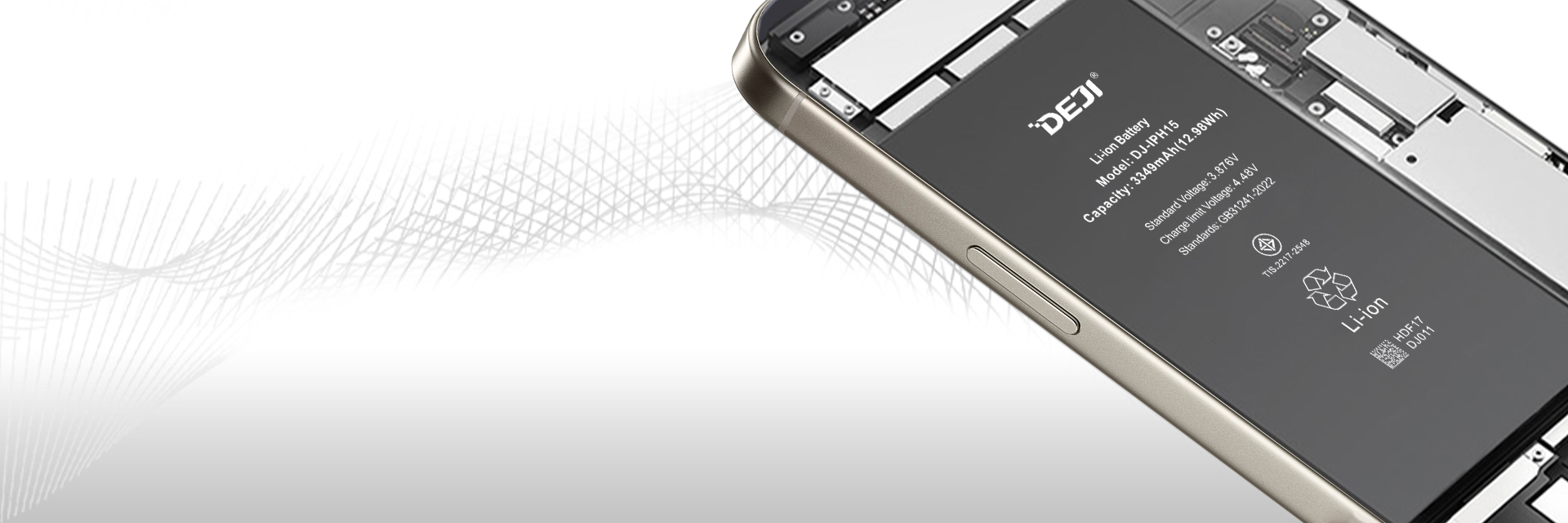

How long should an iPhone battery last? What actually affects battery aging? And what should repair professionals look for when choosing a replacement battery?
There is no single number that answers all three questions.
Battery lifespan depends on the battery chemistry, charge cycles, operating temperature, charging behaviour, device usage — and the quality of the replacement battery itself.
For repair professionals, understanding these factors is more useful than telling customers that a battery will last "one" or "two years."
Quick answer
- An iPhone battery is a consumable. Apple designs iPhone 14 and earlier batteries to retain 80% of original capacity at 500 complete charge cycles, and iPhone 15 batteries to retain 80% at 1,000 complete charge cycles, under ideal conditions.
- Temperature is the single biggest avoidable accelerant of battery aging. Apple advises against exposing a device to ambient temperatures above 35°C (95°F), which can permanently reduce capacity.
- Battery Health does not tell the full story. Runtime, unexpected shutdowns, temperature behaviour, physical condition and cycle history all matter.
- For repair shops, cell quality, batch consistency, protection circuitry and diagnostic behaviour decide whether a replacement battery reduces returns or creates them.
This guide covers how iPhone batteries age, how charging habits and heat affect lifespan, what Battery Health does and does not show, and how professional buyers should evaluate a replacement battery supplier. If you are choosing a battery rather than diagnosing one, start with our guide to choosing a replacement iPhone battery for a repair business.
1. iPhone battery lifespan is more than a cycle count
Lithium-ion batteries gradually lose capacity as they go through charge and discharge cycles.
One complete cycle does not mean charging an iPhone from 0% to 100%. A complete charge cycle is reached when the battery has delivered an amount equal to 100% of its capacity — so using 60% of the battery and later using another 40% is approximately one complete cycle. Apple also normalises a complete cycle between 80% and 100% of original capacity to account for the capacity the battery has already lost.
How many cycles does an iPhone battery last?
Apple publishes cycle-life targets per generation. Under ideal conditions, Apple states:
| iPhone generation | Designed to retain | At |
|---|---|---|
| iPhone 14 models and earlier | 80% of original capacity | 500 complete charge cycles |
| iPhone 15 models | 80% of original capacity | 1,000 complete charge cycles |
Source: Apple — iPhone battery and performance.
Two caveats matter when you repeat these figures to a customer. First, "under ideal conditions" is doing real work in that sentence — the exact percentage depends on how the device is regularly used and charged. Second, Apple publishes these targets by generation, so check the current support page rather than assuming a figure carries forward to newer models.
The practical point for repair professionals: cycle count is a useful indicator, but it is not the whole story. Temperature, charging patterns, workload and the cell's original quality all move real-world performance away from the design target.
2. What actually happens inside an aging iPhone battery?
Battery aging is a chemical process.
During normal operation, reactions inside a lithium-ion cell gradually reduce the amount of lithium available for reversible energy storage. The interfaces between the electrode materials and the electrolyte also change over time.
As the battery ages:
- Maximum capacity can decrease
- Internal resistance (impedance) can increase
- The ability to deliver peak power can change
- Runtime between charges becomes shorter
Impedance is the mechanism behind a symptom customers describe as "the phone just dies." Apple explains that a battery with higher impedance cannot always supply the instantaneous power the system demands, so voltage drops further under load — and once the operations can no longer be supported, the system performs a shutdown to protect the electronics. That shutdown is deliberate from the device's perspective, but unexpected for the user. Apple notes the likelihood rises when the battery has a low state of charge, a higher chemical age, or is in cold temperatures.
This is why two batteries with the same nominal capacity can deliver completely different real-world results.
For replacement batteries, cell quality and manufacturing consistency matter just as much as the number printed on the label. The measurable cell characteristics that drive this are covered in our breakdown of the 8 key parameters of lithium-ion batteries.
3. iPhone Battery Health does not tell the whole story
Battery Health is the most visible indicator on an iPhone, but it is not a complete battery diagnostic report.
Maximum Capacity represents the battery's estimated capacity relative to when it was new. As the battery ages, this value normally decreases. Apple also notes that depending on the gap between manufacture and activation, a battery can legitimately show slightly less than 100% even when new.
Technicians should treat Maximum Capacity as one input among several:
| What to check | Why it matters |
|---|---|
| Actual runtime | The customer's real-world experience, not an estimate |
| Charging behaviour | Slow or unstable charging can indicate the battery, charger, cable or device |
| Unexpected shutdowns | A peak-power delivery problem, not necessarily a capacity problem |
| Battery temperature | Persistent heat under light load signals rising internal resistance |
| Physical condition | Swelling or impact damage is a safety issue, not a performance issue |
| Cycle information where available | Shows how the battery was used, not just how much capacity remains |
| Device performance | Performance management can affect responsiveness independently of the percentage shown |
Is 80% the point where an iPhone battery must be replaced?
No — not universally.
Apple's own wording is that if battery health has degraded significantly, an Apple Authorized Service Provider can replace the battery to restore full performance and capacity, and that this message does not indicate a safety issue — the battery can still be used. The 80% figure is a useful reference point and is tied to how the cycle-life targets are defined, but it is not a rule that every battery must be swapped the moment it reads 79%.
For a repair professional, the customer's actual experience and the battery's physical condition are equally important inputs.
4. How charging habits influence iPhone battery aging
Modern iPhones are designed to support frequent charging. Users do not need to fully discharge the battery before recharging it.
In general, avoiding unnecessary extreme conditions is more useful than following rigid charging rules.
Practical guidance for customers
Avoid prolonged time at a high state of charge when it is not needed. If the iPhone offers Optimized Battery Charging or a Charge Limit feature, these reduce how long the battery sits at a high state of charge. Apple's implementation learns the daily charging routine and may defer charging to 100% until shortly before the device is needed.
Do not deliberately drain the battery to 0%. Partial charging is normal for lithium-ion batteries.
Reduce intensive use when the phone gets hot while charging. Gaming, video recording, navigation and other demanding workloads add heat on top of charging heat. If a battery is going to be stored for a long period, Apple's guidance is to leave it around 50% charge and top it back up to roughly 50% every six months.
The goal is not to make customers follow a perfect 20–80% routine every day. The goal is to reduce unnecessary heat and prolonged extreme operating conditions.
5. Temperature is one of the most important battery-care factors
If there is one battery-care factor repair professionals should emphasise to customers, it is temperature.

Apple's guidance is unusually direct: a device's ideal comfort zone is 16°C to 22°C, and it is "especially important to avoid exposing your device to ambient temperatures higher than 95°F (35°C), which can permanently damage battery capacity." Apple adds that charging in high ambient temperatures can damage the battery further, and that even storing a battery in a hot environment can damage it irreversibly.
Apple also notes that software may limit charging above 80% when the recommended battery temperatures are exceeded — so a device that refuses to charge past 80% in a hot car is behaving as designed, not failing.
Common situations that add thermal stress:
- Direct sunlight
- A hot vehicle
- Intensive gaming while charging
- Sustained high-load applications
- Poor ventilation
- Charging in an already hot environment
A simple recommendation prevents a lot of unnecessary wear: keep the iPhone cool during charging and heavy use.
Apple's advice on cases is worth passing on directly: charging a device inside certain styles of case can generate excess heat that affects battery capacity, so if a phone gets hot while charging, take it out of the case first.
Cold is a different problem — and a less permanent one. Low temperatures temporarily reduce battery life and can trigger shutdowns on an already-aged battery, but performance returns once the battery is back in its normal operating range. Source: Apple — Maximizing Battery Life and Lifespan.
6. How to choose a replacement iPhone battery: capacity is not everything
For repair shops, a replacement battery should not be judged by its mAh rating alone. Capacity is a number on a label; the performance behind it comes from several other things.
| What to evaluate | Why it matters | Question to ask the supplier |
|---|---|---|
| Cell grade | The cell determines fundamental energy-storage behaviour, cycle life and how the battery behaves as it ages | Which cell grade and chemistry is used, and is it new or reclaimed? |
| Protection and management | The protection circuit controls charging, discharging and abnormal conditions | What protection does the board provide, and how is it tested? |
| Batch consistency | Inconsistent batches break a shop's repair process and create repeat labour | What are the accepted tolerances between production batches? |
| Model compatibility | Fitment alone is not compatibility — connectors, capacity and firmware behaviour differ by model | Is this battery designed for this exact model and revision? |
| Diagnostic behaviour | On supported models, warning messages, Battery Health display and status reporting affect the customer's post-repair experience | What does this solution show on the customer's device after installation? |
| Manufacturing control | Production control and testing are what hold quality steady at volume | What are the QC steps and the tested failure rate? |
| Market certification | Documentation requirements differ by destination market | Which certifications cover my destination market? |
That last two rows matter most for B2B buyers ordering in volume, where one weak batch becomes hundreds of comebacks. If you buy in quantity, the practical comparison between battery types is covered in OEM vs premium aftermarket iPhone batteries.
7. DEJI iPhone batteries: options for professional repair
DEJI develops different iPhone battery solutions for different repair and refurbishment requirements, so a shop can match the battery to the job rather than applying one part to every customer.
| Range | Designed for | Typical application |
|---|---|---|
| Standard replacement batteries | Everyday iPhone battery replacement | Walk-in repairs and volume replacement work |
| High-capacity batteries | Customers and repair businesses looking for increased capacity and longer potential runtime, subject to the specific model and product specifications | Upgrades, refurbishment, customers who prioritise runtime |
| Diagnostic batteries | Professional repair and refurbishment applications, with solutions supporting features such as Battery Health display, No Pop-Up experiences, Used status or Genuine status on supported models | Repairs where post-installation system behaviour matters to the customer |
DEJI's high-capacity line includes current-generation upgrades — see the iPhone 16 series high-capacity range (3900–5200mAh) — alongside the full iPhone and Android battery catalogue. For applications where thermal stability is the priority, DEJI also manufactures semi-solid-state smartphone replacement batteries.
8. Diagnostic batteries: built for how iPhone repair actually works now
The iPhone repair industry has changed. Battery replacement is no longer simply:
Remove old battery → install new battery → finish.
Technicians increasingly have to consider system recognition, Battery Health, repair history, diagnostic information and what the customer will see when they get the phone back. Apple's own device behaviour reflects this — on iPhone XS, XR and later, iOS can display messages indicating that a battery cannot be verified, and the Battery Health screen may report that details from that battery may not be accurate.
DEJI diagnostic batteries are developed around those real-world requirements. Depending on the specific model, iOS version and battery solution, DEJI offers options designed around:
- No Pop-Up
- Battery Health display
- Used status
- Show Genuine
- Easier professional installation
- Reduced need for additional battery procedures on supported products
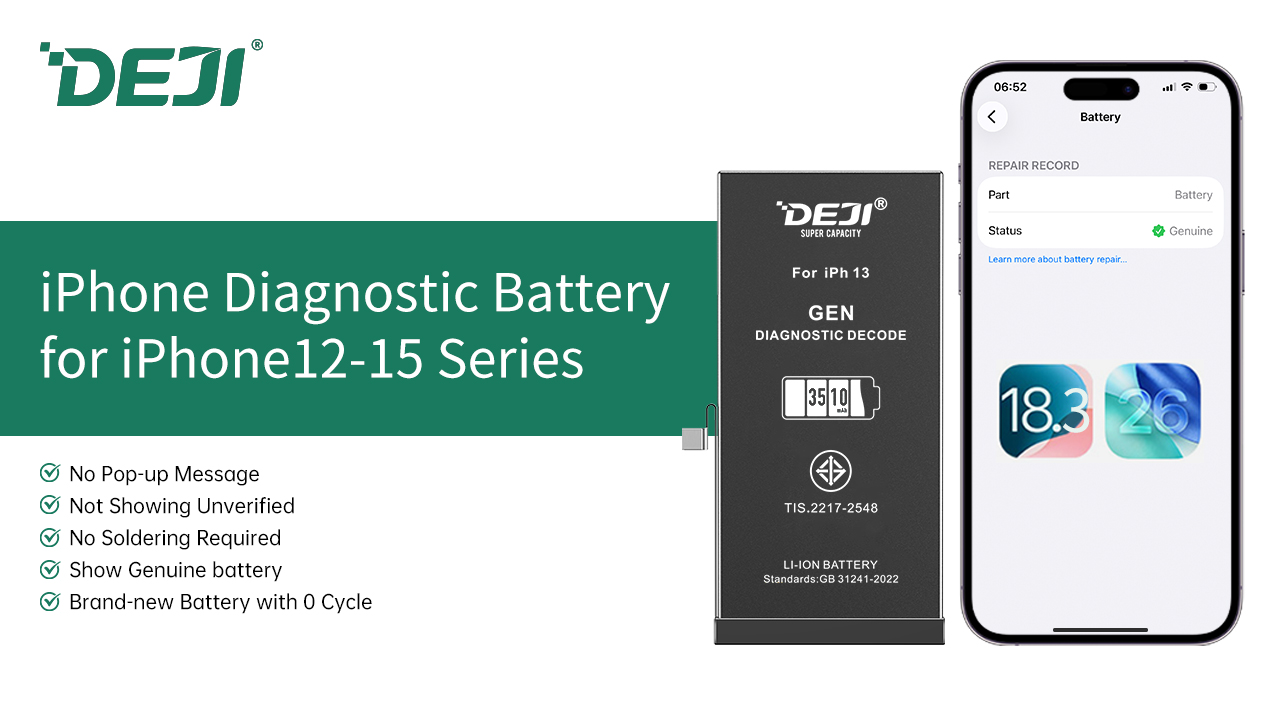
The exact behaviour depends on the iPhone model, iOS version and specific diagnostic battery used — which is why per-model specification, not a blanket claim, is what a buyer should ask for.
Editor note — confirm before publishing: the four status labels above are product claims that must hold per SKU and per iOS version. See Part 4, item 9, for the wording and compliance issue to review with your product team.
9. When should a customer replace an iPhone battery?
Battery Health alone should not determine every replacement decision. Repair professionals should weigh several practical warning signs.
Shorter-than-expected runtime. The phone needs substantially more frequent charging than before.
Unexpected shutdowns. These occur when an aging battery cannot deliver the required peak power under certain conditions — Apple attributes this to increased impedance, aggravated by a low state of charge and cold temperatures. Our article on why an iPhone shuts down with battery percentage remaining covers the diagnosis in detail.
Abnormal charging behaviour. Slow, unstable or unusual charging may point to the battery, charger, cable or the device itself. Diagnose it rather than assuming the battery — and remember that charging can pause or be limited in extreme temperatures by design.
Unexplained heat under light load. A phone that runs hot during messaging or video playback without a hot environment may be showing rising internal resistance rather than a workload problem. See iPhone overheating: causes and how to cool it down.
Physical swelling. A swollen battery is a safety issue. If a battery shows signs of swelling or physical damage, the device should be handled by a qualified technician and the battery should not continue to be used or charged.
For the replacement procedure itself, see our step-by-step guide on when and how to replace your iPhone battery.
10. What makes a professional battery supplier different?
For repair shops, the cheapest battery is rarely the lowest-cost solution.
A battery that performs inconsistently produces costs that never appear on the invoice:
- Additional labour on rework
- Customer complaints
- Returns and replacements
- Repair time lost on warranty jobs
- Damage to the shop's reputation
This is why professional buyers evaluate the supplier as well as the product. Before placing a volume order, get answers to these questions:
- Where are the batteries manufactured? Is the supplier a direct manufacturer or a trader?
- What quality-control process is used, and what is the tested failure rate?
- Are specifications consistent between batches?
- Which certifications cover my destination market?
- Is technical support available after the order — and in what form?
- Can the supplier provide different solutions for different repair applications, or only one part for every job?
- What are the per-model order quantities and lead times?
- What is the warranty and return process when a battery fails in the field?
A supplier that can answer all eight with specifics is a supplier a shop can scale with. Vague answers to questions 2 and 8 are the most reliable predictor of return-rate problems later.
11. Why DEJI
Since 2006, DEJI has developed battery solutions for professional repair and refurbishment markets worldwide, with a portfolio covering smartphone replacement batteries, iPhone high-capacity batteries, diagnostic batteries and other specialised battery solutions.
As published on our company and factory pages:
| Manufacturing base | Shenzhen Huidafa (DEJI) Technology Co., Ltd., founded 2006 — two factories in Shenzhen and Dongguan, over 20,000 m² |
| Capacity | 5 production lines, approximately 200 employees, automated SMT for PCB assembly and automated iPhone/Android battery production |
| Stated quality performance | Repair rate below 0.03%, against a stated industry average of 1%; 100% cobalt A+ grade cells with 0 charge cycles |
| Certifications | CE, FCC, RoHS, PSE, KC, UN 38.3, MSDS, IEC62133, CB, TUV US, UKCA, Anatel; ISO 9001 quality management system |
| Order flexibility | OEM with custom logo and packaging from 200 pcs per model; DEJI-brand and unbranded from 10 pcs per model |
| Delivery | Stocked DEJI-brand batteries, stated 2–5 day dispatch |
For B2B customers, DEJI combines:
Manufacturing experience + product development + quality control + diagnostic solutions + OEM/ODM support
The objective is simple: build battery solutions that work for real repair businesses.
FAQ: iPhone battery lifespan and replacement
How long does an iPhone battery last?
There is no single number. Apple designs iPhone 14 and earlier batteries to retain 80% of original capacity at 500 complete charge cycles, and iPhone 15 models at 1,000 cycles, under ideal conditions. In real use, temperature, charging habits and workload decide how quickly a battery reaches that point. A battery below 80% is not automatically unsafe or unusable — runtime, shutdown behaviour and physical condition determine whether replacement is actually needed.
How many charge cycles does an iPhone battery last?
Apple's targets are 500 complete charge cycles for iPhone 14 models and earlier, and 1,000 complete charge cycles for iPhone 15 models, retaining 80% of original capacity under ideal conditions. A complete cycle is not one charge from 0% to 100% — it is the cumulative delivery of 100% of the battery's capacity.
Is 80% Battery Health the point where the battery must be replaced?
No. 80% is a reference point tied to how Apple defines its cycle-life targets, not a universal replacement trigger. Apple states that significantly degraded battery health does not indicate a safety issue and the battery can still be used. Replacement decisions should also account for runtime, unexpected shutdowns, charging behaviour, heat and physical condition.
Does fast charging damage an iPhone battery?
Apple's published battery guidance centres on temperature rather than charging speed: it advises against ambient temperatures above 35°C, notes that charging in high ambient temperatures can damage the battery further, and states that software may limit charging above 80% when recommended battery temperatures are exceeded. In practice, the heat generated around a charge is the documented risk factor, not the charge rate itself.
Is it bad to charge an iPhone overnight?
Not inherently. Modern iPhones support frequent charging, and features such as Optimized Battery Charging and Charge Limit reduce how long the battery spends at a high state of charge. The more relevant overnight risks are thermal — charging under a pillow, in a case, or in a hot room. Keep the device cool and ventilated while charging.
What temperature damages an iPhone battery?
Ambient temperatures above 35°C (95°F) can permanently damage battery capacity, and charging in high ambient temperatures can damage it further. Apple gives an ideal comfort zone of 16°C to 22°C, with devices working best between 0°C and 35°C. Low temperatures temporarily reduce runtime and can trigger shutdowns on an aged battery, but that effect reverses once the battery returns to its normal operating range.
Are high-capacity iPhone batteries safe?
Capacity itself is not the safety variable — cell grade, protection circuitry, manufacturing consistency and certification for the destination market are. A high-capacity battery from a manufacturer using graded cells, a tested protection board and recognised certifications is engineered to the same safety logic as a standard-capacity part. Unverified, uncertified cells sold on capacity alone are the real risk.
What is a diagnostic iPhone battery?
A diagnostic battery is a replacement battery designed for professional repair and refurbishment workflows, where the battery's interaction with the device after installation matters — Battery Health display, warning messages and status reporting on supported models and iOS versions. Different solutions address different requirements, including No Pop-Up behaviour, Used status or Genuine status, depending on the iPhone model and iOS version.
How should a repair shop evaluate a wholesale iPhone battery supplier?
Ask for specifics on cell grade and origin, protection board testing, batch-to-batch tolerances, the certifications that cover your destination market, per-model order quantities, warranty and return handling, and technical support after the sale. A supplier manufacturing several battery types — standard, high-capacity and diagnostic — can also match the part to the repair application instead of forcing one solution onto every job.
Final takeaway for repair professionals
An iPhone battery does not have a universal expiration date.
Its lifespan depends on chemistry, cycles, temperature, charging behaviour, workload and battery quality.
For technicians, the most useful approach is to look past a single number:
Look at the battery. Look at the device. Look at the customer's usage. Look at the diagnostic information.
And when replacement is required, choose a battery solution that matches the actual repair application.
Source batteries for professional repair
DEJI supplies standard, high-capacity and diagnostic iPhone batteries to repair shops, refurbishers, distributors and wholesalers worldwide — with OEM/ODM support, market-specific certification and technical support after the order.
- Compare the range: DEJI high-capacity iPhone batteries
- Review terms: wholesale and OEM battery programs · shipping and warranty policy
- Meet the team: DEJI at Global Sources Hong Kong
DEJI iPhone Batteries — professional battery solutions for repair shops, refurbishers, distributors and wholesalers.